Four Reasons Antibody Programs Fail Before They Reach Patients
Understanding the Translational Risks Behind Clinical Attrition
Every failed development program has its own story. Different targets. Different modalities. Different diseases. Different clinical outcomes.
Yet when researchers examine why promising antibody programs fail, a pattern emerges. Beneath the complexity of individual programs lie a handful of recurring translational challenges that continue to drive clinical attrition across the industry. The consequences are significant. Years of research, substantial financial investment, and potentially transformative therapies can be lost when critical assumptions about biology prove incorrect in the patient setting.
The question facing development teams is not whether risk can be eliminated, but whether the most common sources of failure can be identified before a candidate reaches the clinic.

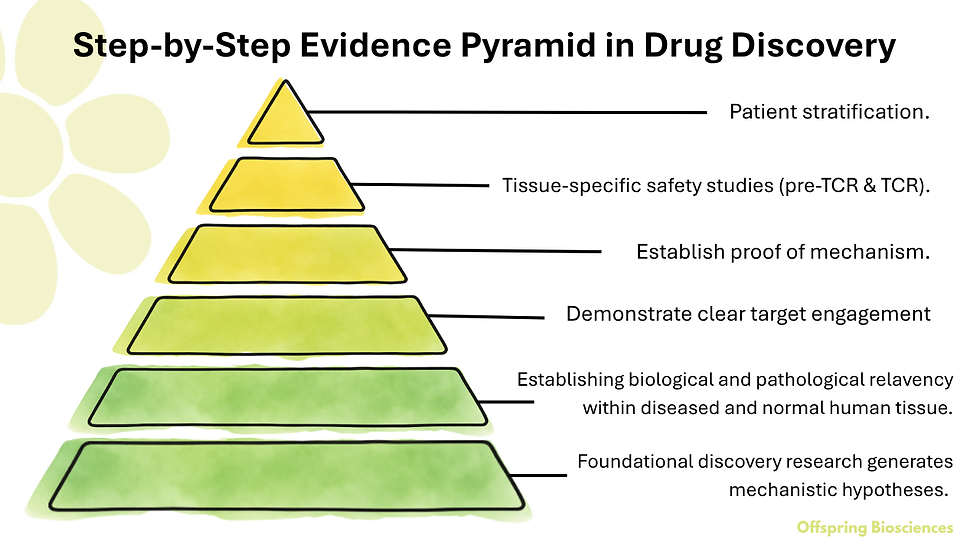
1. The Target Was Never Truly Relevant - Verifying Target Validation
A target can look compelling in a publication, a cell line, or an animal model and still fail to matter in human disease. This is one of the most common translational pitfalls in drug development.
Human diseases are rarely homogeneous. Patients differ in genetics, disease stage, tissue architecture, and molecular expression patterns. A target that appears central within a model system may be absent, inaccessible, or biologically insignificant within the actual patient population.
This challenge sits at the heart of modern translational frameworks such as AstraZeneca's 5R Framework, which emphasizes the importance of selecting the Right Target before advancing development programs.
The critical question is whether or not the intended target is relevant within the diverse pathology of human disease. Without that evidence, development teams risk building entire programs on biological assumptions that fail to translate.
2. The Drug Never Actually Engaged the Target - Verifying Target Engagement
Even when the target is relevant, another challenge remains:
Did the drug actually bind it?
Many programs generate convincing evidence that a therapeutic reaches the intended tissue. Yet tissue presence alone does not confirm molecular engagement. This distinction is particularly important for antibody-based therapeutics, where efficacy often depends on direct interactions between the therapeutic molecule and its intended target.
Standard approaches frequently demonstrate co-localization. They show that both the drug and the target are present within the same tissue region. What they often cannot demonstrate is whether a meaningful molecular interaction actually occurred.
Without evidence of target engagement, researchers may unknowingly advance candidates whose mechanism remains largely unverified in the patient context. The result is a translational blind spot that may not become apparent until clinical efficacy fails to materialize.
3. Toxicity Appears Too Late - Evaluating Patient Safety
For many antibody modalities, including bispecific antibodies and antibody-drug conjugates, efficacy is only one side of the equation. Safety matters just as much.
One of the most challenging aspects of preclinical development is identifying off-target binding before it becomes a clinical problem. A therapeutic may perform exceptionally well against its intended target while simultaneously interacting with healthy tissues in ways that create unacceptable toxicity. These liabilities are often difficult to predict through conventional approaches alone. Unfortunately, they are also among the most expensive failures to discover late in development.
The later a safety issue emerges, the greater the impact on timelines, budgets, and overall program viability. This is why many organizations increasingly prioritize early evaluation of tissue cross-reactivity and off-target binding patterns within human tissue.
The goal is simple: Find the risks before patients do.
4. The Wrong Patients Were Selected - Patient Selection
Not every patient expresses disease biology in the same way.
Yet many development programs continue to recruit patients using broad inclusion criteria that overlook important biological differences between responders and non-responders. This challenge becomes particularly important when target expression varies significantly across the patient population.
A therapeutic may be highly effective in patients with elevated target expression while delivering limited benefit to those with lower expression levels. When these populations are combined, efficacy signals can become diluted, creating the appearance of a weaker therapeutic effect. In many cases, the issue is not the drug, but patient selection and stratification.
Modern digital pathology and biomarker-driven approaches are increasingly helping development teams move beyond subjective scoring systems toward quantitative measurements capable of identifying the patients most likely to benefit from treatment.
As precision medicine continues to evolve, selecting the right patient may become just as important as selecting the right target.
The Common Thread
At first glance, these four challenges may appear unrelated.
Target validation.
Target engagement.
Patient Safety.
Patient selection.
Yet they share a common characteristic: All four involve assumptions about human biology. And all four become significantly more difficult to address once a program has entered clinical development.
The most successful translational strategies increasingly focus on generating human-relevant evidence earlier, when development teams still have the opportunity to refine candidate selection, optimize trial design, and reduce uncertainty before major investments are made.
Before the Cliff
Phase II has often been described as the place where promising biology meets reality.
For many programs, that reality arrives too late.
The good news is that these failure modes are increasingly understood. The challenge is identifying them before they become clinical outcomes.
Learn More
Our white paper, Surviving the Phase II Cliff: The Tissue Insights™ Framework for De-Risking Antibody Development, explores these four translational failure modes in greater detail and examines how human tissue-based approaches can help generate stronger evidence before critical development decisions are made.
Download the full white paper to explore the complete Tissue Insights™ framework and learn how leading development teams are working to reduce translational risk before candidates reach patients.