From Data to Decisions: Why Modular Translational Validation Is Replacing One-Size-Fits-All Drug Development
Despite unprecedented advances in genomics, AI, and high-throughput screening, clinical attrition remains stubbornly high. Roughly 90% of therapeutic candidates fail in clinical development, with late-stage failures costing individual programs hundreds of millions of dollars.
The underlying issue is rarely a lack of scientific rigor. Retrospective analyses reveal that many programs advance without sufficient evidence that their biological assumptions hold true in humans. Promising activity in preclinical models frequently fails to translate into meaningful clinical outcomes because the evidence supporting progression relies too heavily on proxy systems rather than direct human biology.
How the Shift to Structured Decision-Making Frameworks Mitigates Translational Risk in Modern Drug Development
Major pharmaceutical organizations have actively adapted to this reality. Pfizer’s Three Pillars of Survival and AstraZeneca’s 5R Framework represent systematic shifts away from traditional, milestone-based development. Following extensive reviews of clinical failures, these companies concluded that successful translation requires demonstrating sufficient drug exposure, target engagement, and biological relevance before advancing candidates into costly later-stage development.
These frameworks share a core philosophy: successful translation requires demonstrating biological relevance, specifically within human tissue.
Animal studies, in vitro systems, and computational modeling remain indispensable for investigating mechanisms and generating hypotheses. However, relying exclusively on them to predict human clinical outcomes carries significant risk.
Case in Point: TGN1412
Animal studies suggested a highly favorable safety profile for TGN1412, yet six healthy volunteers experienced severe cytokine release syndrome during the first-in-human trial. Subsequent analyses showed critical differences in CD28 expression between humans and cynomolgus monkeys. It is a stark reminder of how species-specific biology can undermine otherwise robust preclinical data.
The same pattern shows up beyond acute safety events. Several Alzheimer's disease candidates reduced amyloid burden and improved cognition in transgenic mouse models, only to fail to demonstrate meaningful benefit in patients - not because the science was wrong, but because the models could not confirm whether the drug was truly engaging its target within the architecture of human disease. Two very different failure types, safety and efficacy, traced back to the same root cause: a model that was never asked to answer a human-specific question.
For a deeper look into landmark case studies where models masked critical differences in pathology and drug performance, explore our companion piece ...
Bridging Translational Gaps with Modular Validation
Historically, many translational programs have relied on a narrow collection of experimental approaches to answer a diverse set of biological questions. A successful animal study or a favorable binding assay often bears the weight of conclusions extending well beyond its design.
Demonstrating that a target is expressed in diseased tissue is fundamentally different from confirming physical target engagement. Proving engagement differs again from verifying biological response or screening for off-target liabilities. Attempting to answer all these questions with a single experimental technique inevitably creates critical evidence gaps.
This principle is the foundation of the Tissue Insights™ platform. Rather than organizing services strictly by laboratory technique, the platform groups complementary methods into modular evidence packages. Each module is designed to reduce uncertainty at a specific developmental hurdle, collectively providing a comprehensive understanding of program readiness.
Each of these questions is, at its core, a question about human tissue: whether a target's expression pattern, a drug's binding behavior, or a downstream biological response holds true in the actual architecture of human disease - not in an approximation of it. This is the thread connecting Pfizer's Three Pillars, AstraZeneca's 5R Framework, and every module below: different vocabularies, same underlying demand for human-relevant evidence.
Scientific Question | Type of Evidence Required | Tissue Insights™ Module | Representative Techniques |
Is this the right biological target? | Human disease relevance and spatial expression | Module 1 | Multiplex IHC, RNAscope, Digital Pathology |
Which candidate should move forward? | Comparative efficacy and lead selection | Module 2 | Comparative tissue profiling, Biomarker analysis |
Does my drug actually engage its target? | Proof of Mechanism | Module 3 | Receptor Autoradiography, isPLA, In Vivo Immunodecoration |
Is it safe in human tissue? | Off-target binding and tissue specificity | Module 4 | Tissue Cross-Reactivity, Tissue Microarrays |
Who is most likely to benefit? | Patient stratification and biomarker discovery | Module 5 | Spatial biomarker analysis, AI image analysis |
For a practical breakdown of the analytical methods and scientific rationale driving each of these decision points, download our technical guide ...
Constructing a Step-by-Step Evidence Pyramid for IND Readiness
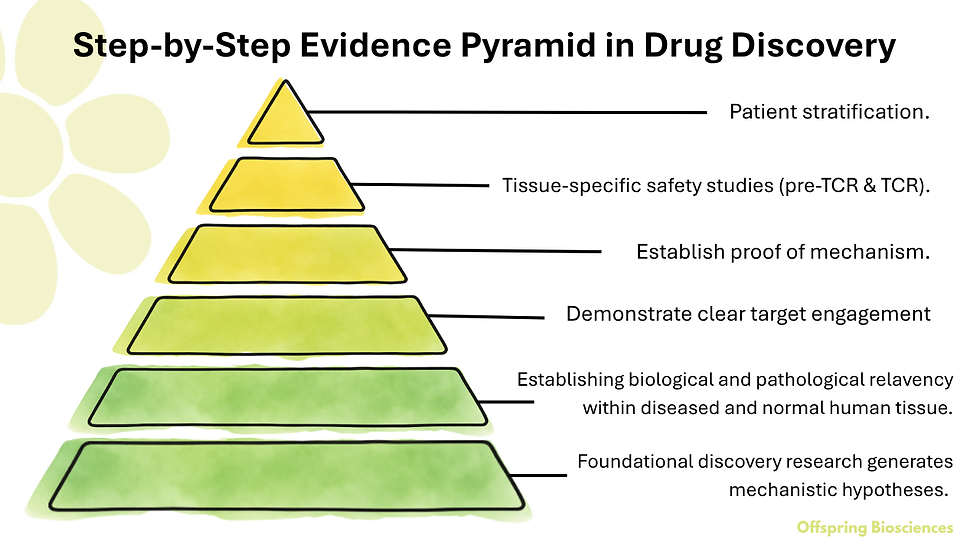
Modern translational medicine constructs evidence like a pyramid, with each layer supporting the next.
Foundational discovery research generates mechanistic hypotheses. The immediate next layer must establish whether this same biology exists within human tissue. Once pathological relevance is established, programs can confidently progress toward demonstrating target engagement, proof of mechanism, tissue-specific safety, and patient stratification.
Viewed this way, translational medicine is the deliberate construction of an evidence pyramid where every layer strengthens the scientific justification for exposing patients to a new therapy.
At Offspring Biosciences, the Tissue Insights™ platform was built to help sponsors navigate this exact progression. By applying modular spatial biology and human tissue profiling, programs can build a progressively stronger body of human-relevant evidence before entering the clinic. This directly reduces translational uncertainty and supports informed, highly confident Go/No-Go decisions.
To explore the complete Tissue Insights™ framework and discover how integrating human tissue validation early in your pipeline can help you navigate these exact translational risks, download our white paper, Surviving the Phase II Cliff.
If you'd like to discuss how adopting a modular framework to evidence validation can help operationalize your drug pipelines, reach out for a no-obligation consultation, scientist to scientist.